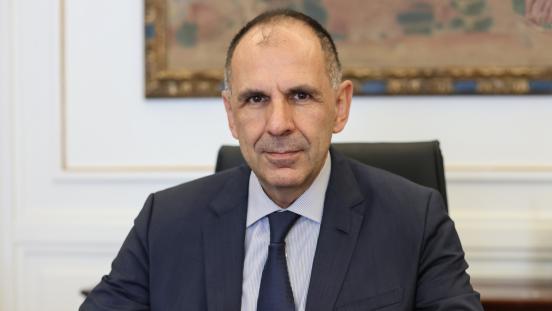


17th U Thant Distinguished Lecture: President Rafael Correa of Ecuador
September 7 from 10:40 at UNU HQ
Women Making Peace: Where Are We Now?
Public symposium on the impact of Security Council resolution 1325 • September 8 from 14:30 at UNU HQ
UNU-ISP Advanced Seminar Series (Tokyo)
Apply now for 15-week courses in (i) Disaster Management and Humanitarian Assistance and (ii) Climate Change, Energy and Food Security.
Japan-CARICOM Public Symposium
Climate Change and Biodiversity

Carolyn Rodrigues-Birkett, Minister of Foreign Affairs, Republic of Guyana, speaks at the Japan-CARICOM Public Symposium on Climate Change and Biodiversity. Photo: Curtis Christophersen/UNU
2010.09.02 • The Caribbean Community (CARICOM, consisting of fifteen member states and five associate member states of the Caribbean region) represents one of the most biologically diverse regions on the planet. These Small Island Developing States are facing pressing threats including loss of biodiversity, and are extremely vulnerable to the effects of climate change, such as frequent and intense hurricanes, subsequent flooding and erosion, and rising sea level, that threaten livelihoods and human well-being
On the occasion of the Second Japan-CARICOM Ministerial-Level Conference held in Tokyo, on 2 September 2010 a Japan-CARICOM Public Symposium on Climate Change and Biodiversity was organized by the United Nations University (UNU), Ministry of Foreign Affairs of Japan (MOFA) and Inter-American Development Bank (IADB), and supported by the Japan International Cooperation Agency (JICA). This public dialogue, held in the United Nations University U Thant Hall in Tokyo, convened Caribbean ministerial level and Japanese senior academics and experts to exchange views on the Caribbean region's urgent climate change and biodiversity issues, as well as on issues of Caribbean society, economy and culture. Particpants also explored future cooperation between CARICOM and Japan
The symposium began with opening remarks by Shuji Kira (Parlimentary Vice-Minister for Foreign Affairs of Japan), Konrad Osterwalder (UNU Rector) and Yoshihisa Ueda (Representative of the IDB Office in Asia). Keynote speakers were Louis Straker (Deputy Prime Minister and Minister of Foreign Affairs, Commerce and Trade, Saint Vincent and the Grenadines), Maxine McClean (Minister of Foreign Affairs and Foreign Trade, Barbados), Charles Peter David (Minister for Foreign Affairs and Tourism, Grenada) and Carolyn Rodrigues-Birkett (Minister of Foreign Affairs, Republic of Guyana).
Key outcomes of the symposium include recognition of a sense of urgency in addressing the issues facing the Caribbean; recognition of the importance of capacity building as a pillar for climate change adaptation in the Caribbean; identification of the potential for cooperation in use of technology, training and knowledge transfer for climate change adaptation; and a willingness by the organizers to further engage in the region.
Town Hall Meeting
Secretary-General Addresses UN Staff in Tokyo

UN Secretary-General Ban Ki-moon and UNU Rector Konrad Osterwalder at the town hall meeting held at UNU Headquarters in Tokyo. Photo: Curtis Christophersen/UNU
2010.08.04 • UN Secretary-General Ban Ki-moon addressed UN staff in Tokyo at a town hall meeting at UNU Headquarters today. Mr. Ban is visiting Japan to meet with Prime Minister Kan, Minister of Foreign Affairs Okada, and other senior officials and to attend ceremonies on the occasion of the 65th anniversary of the atomic bombings of Japan.
At the town hall meeting, moderated by UNU Rector Konrad Osterwalder, Mr. Ban said that the core theme of his visit was peace and disarmament. He hoped to send a strong message, he said, through his presence. On Friday, August 6, Mr. Ban will become the first secretary-general to attend the Hiroshima Peace Memorial Ceremony.
Before taking questions from the audience, Mr. Ban also spoke of the creation of a new agency for women and gender equality. UN Women will unite those entities and programmes now working on these issues.
See also:
Meeting between Mr. Naoto Kan and Mr. Ban Ki-Moon
Ministry of Foreign Affairs, 2010.08.04
Meeting between Mr. Katsuya Okada and Mr. Ban Ki-Moon
Ministry of Foreign Affairs, 2010.08.03
Regional Governance: Challenges and Opportunities
UNU Holds First Global Seminar in the Caribbean

Particpants in UNU's first Global Seminar in the Carribean, Trinidad and Tobago. Photo: Aneel Karim, UWI (see more photographs on Flickr)
2010.07.20 • The United Nations University recently held its first global seminar in The Caribbean. The seminar, hosted by the Institute of International Relations (IIR), University of the West Indies (UWI), St. Augustine Campus, Trinidad and Tobago on the theme “Regional Governance: Challenges and Opportunities” was held from June 28 to 30. In his opening remarks, Timothy M. Shaw, the director of the Institute of International Relations at UWI stated that the UNU Global Seminar would build on existing networks between UWI and other United Nations agencies, and as UNU’s first seminar in the Caribbean region, would open new opportunities for research collaboration between UNU researchers and researchers in the region.
In his keynote remarks, UNU Vice-Rector Kazuhiko Takeuchi presented UNU’s current and future plans for graduate programmes, twin institutes, and integrated interdisciplinary approaches to global sustainability challenges. Following Prof. Takeuchi’s remarks, John Agard, a renowned climate scientist, spoke on the relevance of sustainability science and the importance of developing an interdisciplinary understanding.
The seminar was attended by 45 students selected mainly from the undergraduate and graduate programs at UWI and the United Nations Youth Association for Trinidad and Tobago. The seminar featured 15 guest lectures delivered by leading experts selected from UWI, the Ministry of Foreign Affairs of Trinidad and Tobago, UN agencies and regional organizations based in Trinidad. Some of the guest lecturers included Anita Montoute, Matthew Bishop, Mark Kirton, Michele Reis (all from UWI), Luis Andrade Fall of the Association of Caribbean States, Jens Ulrich Poppen from UN Volunteers, and Reita Gabrielle of the Ministry of Foreign Affairs.
The seminar was jointly facilitated by Obijiofor Aginam of the UNU Institute for Sustainability and Peace, Tamara Brathwaite (IIR, UWI), Amanda Laurence (UNIC), and Solange Cross-Mike (IIR, UWI) who supervised the group work and presentations of the students on four topics related to the challenges of regional governance in the Caribbean region.
Peacebuilding in Conflict-Affected Societies
Workshop explores local peacebuilding experiences and perspectives

Workshop participants gathered in Sarajevo to explore local perspectives in peacebuilding.
2010.07.19 • UNU-ISP and McMaster University (Ontario, Canada) held a workshop at the University of Sarajevo from June 23 to 25 as part of a joint research project which draws upon local perspectives to deepen understanding of peacebuilding challenges, and thereby recommend ways to improve UN and inter-governmental approaches to peacebuilding.
The workshop engaged local researchers, policy analysts and practitioners with experience of peacebuilding activities in their own countries, including Croatia, Guatemala, Kosovo, Mozambique and Timor-Leste, as well as Bosnia-Herzegovina. It explored the successes and failures of peacebuilding in these countries, from conflict prevention and conflict resolution to the process of post-conflict reconstruction, including economic development, democracy assistance and good governance, strengthening the rule of law, demobilization and reintegration of armed combatants, and reconciliation.
The Sarajevo workshop builds upon a previous workshop held in Accra, Ghana, in September 2009, featuring experts on peacebuilding in Afghanistan, Burundi, Kosovo, Liberia, Mozambique, Rwanda and Sierra Leone.
Analysis of local needs and ownership in peacebuilding remains underdeveloped, and local voices are not always present. The UNU-ISP project “Peacebuilding in Conflict-Affected Societies: Comparative Experiences and Local Perspectives” addresses these shortcomings by considering local experiences and perspectives in four areas: the legacy of violent conflict; local resources and capacity; scope, priority and sequencing of peacebuilding activities; and the balancing of local and international engagement.
The project outcomes will be disseminated through an edited academic volume, a UNU Research Brief, and a workshop report to be published in the Journal of Peacebuilding and Development.
Research Brief: Towards a Human Security Approach to Peacebuilding
For more information, contact Madoka Futamura, UNU Institute for Sustainability and Peace.
Patricia Espinosa Cantellano, COP16 Chair, Speaks at UNU
Towards Cancún 2010: Setting the stage for COP16

Patricia Espinosa, Secretary of Foreign Affairs of Mexico, and Konrad Osterwalder, United Nations University Rector, exchange gifts of books prior to Ms. Espinosa’s public lecture at UNU Headquarters, Tokyo, on 5 July 2010.
Photo: Jeremy Hedley/UNU
Watch a video interview with Amb. Espinosa
Patricia Espinosa on UNU’s Vimeo Channel (Flash video)
Watch the lecture on UNU’s video portal
Patricia Espinosa: Towards Cancún 2010
Amb. Espinosa’s remarks
Presentation by Ambassador Patricia Espinosa, Secretary of Foreign Affairs of Mexico, at the United Nations University, Tokyo, 5 July, 2010
2010.07.07 • Patricia Espinosa, Mexico’s secretary of foreign affairs and the chair of COP16, spoke at UNU July fifth on Mexico’s preparations for the COP16 climate summit to be held in Cancún later this year.
As the host country for the 16th session of the Conference of the Parties (COP16) to the United Nations Framework Convention on Climate Change, Mexico is determined to push for substantive agreements from all parties.
Ms. Espinosa’s lecture followed Mexican president Felipe Calderón’s February U Thant Distinguished Lecture at UNU Headquarters in which the president emphasized the need to rebuild confidence and trust following the disappointing COP 15 climate summit in Copenhagen last December.
In her lecture, Ms. Espinosa stressed the need for inclusive dialogue, especially with least developed countries, island states, and the private sector, as a key component in the quest for a binding agreement in Cancún.
Prior to her lecture, Ms. Espinosa met with UNU Rector Konrad Osterwalder to discuss the COP process and UNU’s role.
New Initiatives Planned for UNU-IIST
Prof. Peter Haddawy Appointed Director of UNU-IIST
2010.06.25 • On 16 June, Professor Peter F. Haddawy joined the United Nations University as Director of the Macao-based UNU International Institute for Software Technology (UNU-IIST).
“Over its 18-year history, UNU-IIST has made important contributions to the development of research capacity in computer science in Asia and the developing world”, said Director Haddawy.” The time has come to adjust the UNU-IIST mission toward applying its strengths in computer science to addressing some of the most challenging problems of sustainable development.” He added that he anticipates announcing a number of new initiatives for the Institute in the coming months.
Prior to joining UNU-IIST, Prof. Haddawy served as Vice President for Academic Affairs at the Asian Institute of Technology (AIT; Bangkok, Thailand), and as Professor of Computer Science and Information Management in the AIT School of Engineering and Technology.
UNU-ISP New Postgraduate Programme
Master of Science in Sustainability, Development, and Peace
The United Nations University Institute for Sustainability and Peace will start its new postgraduate programme, the Master of Science in Sustainability, Development, and Peace.
Intended for recent graduates, professionals, and practitioners, the programme addresses pressing global issues of sustainability, climate change, development, peacebuilding, and human rights through an innovative interdisciplinary approach that integrates the natural sciences, social sciences, and humanities.
The programme is designed to provide students with the knowledge and skills to make important contributions towards solving global issues, whether through employment by UN agencies, other international organizations, governments, civil society, or the private sector.
UNU-ISP Postgraduate Programme
56 Students, 37 Countries
2010 International Courses Conclude

Students and staff gather for the conclusion of the 2010 UNU International Courses.
2010.06.18 • Our congratulations to the students of the 2010 UNU International Courses who marked the completion of their studies today with a closing ceremony at UNU Headquarters in Tokyo after six weeks of intensive work.
IC students take a core course entitled “The UN System: Pressing Issues and Sustainable Solutions” and then select the remainder of their studies here from other thematic areas: peace and human rights; global change and sustainability; and international development and cooperation.
Greening the Blue
Improving the UN’s Internal Sustainability Performance
2010.06.04 • A new website, www.greeningtheblue.org, has been developed to improve the UN’s communications on it’s internal sustainability performance and is being launched on Friday 4 June as part of the celebrations for World Environment Day (Saturday 5 June).
Greening the Blue shows what is happening to make the UN more sustainable and provides advice to staff on how they can reduce the environmental footprint of their work.
New from UNU Press
Usable Thoughts
Michael H. Glantz and Qian Ye
Short quotations are often used to stimulate thought and evoke discussion. The intention of this book is no less ambitious. Drawing upon a series of quotations taken from the World Meteorological Organization-sponsored publication, Climate: Into the 21st Century, the authors set out to encourage thought and discussion on the earth’s climate system, including its interrelatedness to human society and the environment, the impact of climate variability, and climate extremes and change. Read more…
Download our 2009-2010 catalogue
(12 MB PDF)
UNU Lectures
U Thant Lecture Series
The U Thant Distinguished Lecture Series is a forum through which eminent thinkers and world leaders speak on the role of the United Nations in addressing the challenges facing the world’s peoples and nations in the twenty-first century.
Nansen Lectures
The Fridtjof Nansen Memorial Lecture is held annually in a number of capitals around the world to commemorate the birth of the Norwegian explorer, scientist, humanist and Nobel laureate, Fridtjof Nansen (1861–1930).
Fridtjof Nansen Lecture Series![]()
Nagai Lectures
Named in honour of the late Dr. Michio Nagai, minister of education, science, and culture of Japan, these lectures provide a forum for eminent members of the international community to speak on issues related to education.
Sixth Michio Nagai Lecture (Video portal)![]()
◊◊◊
Page last modified 2010.09.06.